
You are here
SOC Changes
Globally, soils store approximately 2135 Gt of soil organic carbon (SOC) in the first metre making them the largest terrestrial reservoir of carbon. However, factors such as land use and management practices coupled with rising temperatures due to climate change, may potentially trigger a transition of soils from carbon storage to becoming a significant source of atmospheric carbon dioxide (CO2).
In this context, the European Commission strengthens the contribution of the land use, land use change and forestry (LULUCF) sector to the European Union's (EU) increased climate ambition and recognizes the need to reverse the current declining trend of carbon removals (McGrath et al., 2023). The EU Soil Strategy 2030, ‘Reaping the benefits of healthy soils for people, food, nature, and climate’ (COM(2021) 699 final), recognizes that targeted and sustained sustainable soil management practices can contribute to achieve climate neutrality by increasing the amount of C stored in agricultural soils.
The EU Soil Strategy 2030 aims to increase soil organic carbon (SOC) in agricultural land to enhance soil health and support biodiversity as well as to offset greenhouse gas emissions through soil carbon sequestration. Therefore, the quantification of current SOC stocks and the spatial identification of the main drivers of SOC changes is paramount in the preparation of agricultural policies aimed at enhancing the resilience of agricultural systems in the EU. In this context, changes of SOC stocks (Δ SOCs) for the EU + UK between 2009 and 2018 were estimated by fitting a quantile generalized additive model (qGAM) on data obtained from the revisited points of the Land Use/Land Cover Area Frame Survey (LUCAS) performed in 2009, 2015 and 2018. The analysis of the partial effects derived from the fitted qGAM model shows that land use and land use change observed in the 2009, 2015 and 2018 LUCAS campaigns (i.e. continuous grassland [GGG] or cropland [CCC], conversion grassland to cropland (GGC or GCC) and vice versa [CGG or CCG]) was one of the main drivers of SOC changes. The CCC was the factor that contributed to the lowest negative change on Δ SOC with an estimated partial effect of −0.04 ± 0.01 g C kg−1 year−1, while the GGG the highest positive change with an estimated partial effect of 0.49 ± 0.02 g C kg−1 year−1. This confirms the C sequestration potential of converting cropland to grassland. However, it is important to consider that local soil and environmental conditions may either diminish or enhance the grassland's positive effect on soil C storage. In the EU + UK, the estimated current (2018) topsoil (0–20 cm) SOC stock in agricultural land below 1000 m a.s.l was 9.3 Gt, with a Δ SOC of −0.75% in the period 2009–2018. The highest estimated SOC losses were concentrated in central-northern countries, while marginal losses were observed in the southeast.
Modelling approach: The qGAM was employed to estimate the location-specific median of Δ SOCc across EU and UK. GAM models are semi-parametric regression models that have the ability to capture the nonlinear relationship between response and explanatory variables, via so-called smooth effects.
Data source: The response variable Δ SOCc, expressed as the arithmetic differences between SOC content of 2018 and 2009 was calculated from the revisited points of LUCAS soil surveys collected from specific agricultural lands (i.e. cropland and grassland). The LUCAS survey is a project to monitor land use and land cover changes across the EU. A soil module was performed in 2009, 2015 and 2018 across EU Member States. The LUCAS programme is the largest comprehensive and harmonized source of topsoil data across the EU. For each survey around 22,000 locations spanning various land covers were sampled and analysed for their physical and chemical properties following ISO standard procedures. The sample analyses were performed by a single laboratory, contributing to data comparability by avoiding uncertainties due to analysis based on different methods or different calibrations in multiple laboratories. Further details regarding LUCAS soil module and soil related chemical analysis can be found in Orgiazzi et al. (2018). Of the roughly 22,000 initial locations sampled across all land uses in the 2009/12 soil survey, 5722—specifically from cropland and grassland—were revisited in the two subsequent soil surveys (2015 and 2018). These 5722 locations underwent filtering to exclude sites with organic-rich soils (SOC > 160 g C kg−1), those with over 5% CaCO3, and those missing either SOC values or particle size analysis, leaving 5307 locations. Additionally, a meticulous quality control process was implemented to pinpoint changes between 2009 and 2018 unrelated to agricultural practices.
 |  | |
| (a) Soil organic carbon (SOC) content by land use/land use change (C, cropland; G, grassland) and (b) correspondent Δ SOCc in the period 2009–2018 based on LUCAS soil survey d | Spatial prediction of Δ SOCs (0–20 cm) using qGAM during the 2009–2018 period for (a) q0.5, (b) q0.25 and (c) q0.75. (d) Latitudinal variations of mean Δ SOCs (0–20 cm) for qGAMs and DayCent. Map lines delineate study areas and do not necessarily depict accepted national boundaries. qGAM, quantile generalized additive model; SOC, soil organic carbon. |
Changes in SOC content by land use class between 2009 and 2018 confirm the beneficial gain in SOC content obtained from continuous grassland or the conversion of cropland to grassland. Continuous grassland (GGG) or the conversion of cropland to grassland (CGG) could contribute to an increase in SOC content by 0.48 ± 0.01 and 0.33 ± 0.04 g C kg−1 year−1, (~1.2 and 0.8 t C ha−1 year−1 respectively) across European pedoclimatic condition.
Data: Download the Changes in Soil Organic Carbon in Croplands and Grasslands between 2009 and 2018 (single TIFF file at a 500m resolution) as g Kg-1.
Reference: De Rosa, D., Ballabio, C., Lugato, E., Jones, A., Panagos, P. 2023. Soil organic carbon stocks in European croplands and grasslands: How much have we lost in the past decade? Global Change Biology. DOI: https://doi.org/10.1111/gcb.16992.
Go Back To
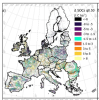 |
Title: Changes in Soil Organic Carbon in Croplands and Grasslands between 2009 and 2018 | |
|
Resource Type: Datasets, Soil Threats Data Theme/Sub-Theme: Soil Organic Carbon Content, SOC Changes, Agricultural SOC Stocks, Topsoil Soil Organic Carbon (LUCAS) Registration requested: Request Form |
Continent: Year: 2023 Keywords: SOC |
|

