
You are here
Soil Bulk Density assessments
Bulk density is an important parameter for understanding the physical, chemical and biological soil properties Dry bulk density and total porosity are the most frequently used indicators to characterize the state of compactness of a topsoil.
Accurate bulk density data is important for the determination of soil porosity and soil moisture. Bulk density is inversely related to soil porosity which shows the space left in the soil for air and water movement. Bulk density is used as a proxy indicator to determine the soil compaction stress in topsoils In addition, the bulk density can be determinant for the penetration stress and therefore influence the availability of fertilizers to plants and their efficiency . Accurately measuring bulk density is crucial for refining estimates of soil organic carbon stocks and their changes in time and space . The precise determination of soil bulk density holds particular significance in carbon crediting schemes, where farmers receive credits based on the absolute amount of carbon sequestered. However, it is important to acknowledge that measurements of soil bulk density are prone to random errors, which can reach up to 40%. Moreover, in soils with high rock fragment content (> 30 vol%), this error is further exacerbated, reaching up to 100% if gravel content is not taken into account. Bulk density is calculated as the ratio of dried soil mass to its volume(Blake, 1965; Hillel, 1980):
ρb = Ms / Vs
ρb is estimated as Mg m−3 while Ms is the weight (Mg) and Vs the volume of the sampled dry soil (in m3). In many other cases bulk density is reported as g cm−3.
Data inputs: The LUCAS topsoil survey includes ∼20,000 points in the EU with measured physical, chemical, and biological properties. The LUCAS 2018 was the 3rd topsoil sampling campaign following the 2009 and 2015. The LUCAS 2018 soil introduced new modules for analysis in a limited number of samples due to budget restrictions. Those new modules include the assessment of soil biodiversity, pesticides residues, assessment of soil erosion features and bulk density.
For the 2018 LUCAS campaign, bulk density was measured on approximately 6000 locations across EU+UK. Even if the total LUCAS topsoil surveyed samples are almost 20,000, the bulk density analysis was limited to the 6000 points due to budget constraints. Bulk density was determined at various depth levels: 0–10 cm (6246 points), 10–20 cm (5786 points), and 20–30 cm (140 points, only for Portugal). Moreover, for locations where measurements were available for both 0–10 cm and 10–20 cm depths, the bulk density (BD) at the 0–20 cm stratum was computed by averaging the measurements from the 0–10 cm and 10–20 cm depths across 5659 points.
The spatial interpolation of soil bulk density was performed using the Cubist regression trees.

The median bulk density for the 0–10 cm is 1.1 g cm−3 (mean: 1.04 g cm−3) with the 25th percentile at 0.85 g cm−3 and the 75th percentile at 1.29 g cm−3 . The median bulk density for the 10–20 cm is 1.18 g cm−3 (mean: 1.13 g cm−3) which is 7% higher compared to the 0–10 cm. This layer has the 25th percentile at 0.95 g cm−3 and the 75th percentile at 1.36 g cm−3.
The main driver for bulk density variation is the land cover type. Croplands have almost 1.5 times higher bulk density compared to woodlands. Arable lands have the highest mean BD at 1.26 g cm−3 followed by permanent crops (BD= 1.23 g cm−3), heterogeneous agricultural areas (BD= 1.14 g cm−3), pastures (BD= 1.08 g cm−3), shrublands (BD= 1.01 g cm−3) and woodlands (BD= 0.84 g cm−3). In most cases, forest soils have much lower values in their upper layer (0–10 cm) due to its richness in organic matter and biotic activity.Compared to past estimates of bulk density which were based on pedotransfer rules, we found an overestimation of bulk density in woodlands (∼25%) compared to the measured bulk density in LUCAS 2018 survey.
The pan European assessment of bulk density does not challenge any local or regional assessment which have developed with higher density of analysed samples. We acknowledge that the LUCAS topsoil database of 6000 samples is limited for a pan European study but this is the most comprehensive EU survey till now. Some issues with non-accessibility of points did not allow to have a much higher number of samples for the analysis. The sampling time is also an important factor which may add uncertainties to the bulk density values. The management practices of a farmer (tillage, harvesting) may influence the composition of the sample and the derived BD values. Also, in grasslands, the livestock density and grazing are important missing information for better interpreting bulk density in LUCAS. The size of the coring cylinder (rings) used, the operator experience, and in-situ soil moisture content significantly affect BD accuracy.

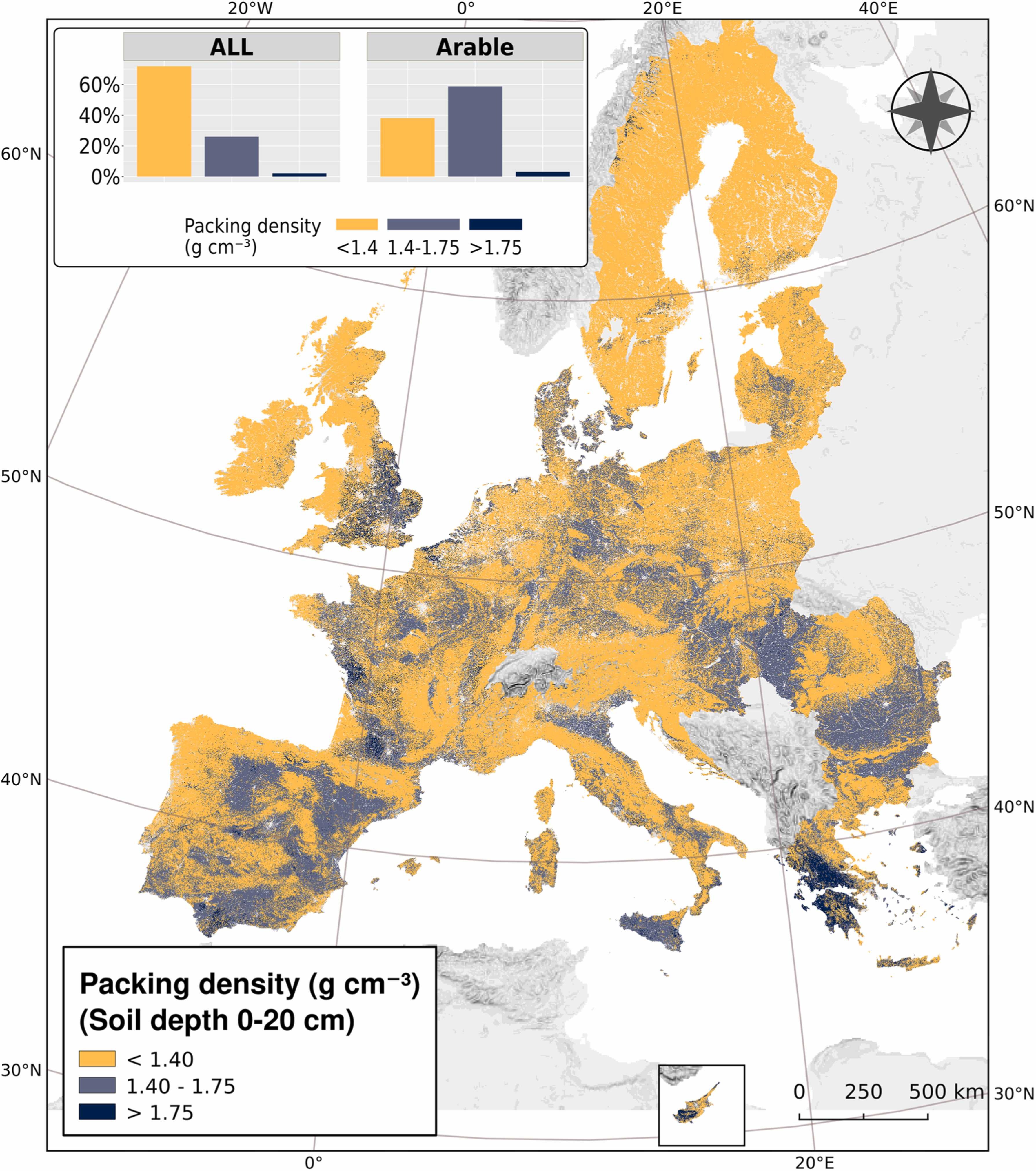
Bulk density is mainly driven by land cover type with croplands having the highest BD and woodlands the lowest in all depths. As the soil BD is the mass of dry soil per unit volume, then the relationship between soil compaction and its capacity to store and transport water or air is obvious. As the vertical stress in soils is part of modelled soil compaction, the bulk density can estimate this vertical stress to topsoil. Soil compaction is a major threat to soils particularly in intensively agricultural systems. Soil compaction is known to reduce agricultural productivity, decrease crop yields, decrease water infiltration and accelerate run-off and risk of soil erosion.We estimated the packing density (PD) using the pedotrasfer rule and as inputs the bulk density map and the clay content. The Packing Density (PD) is a measure of compactness of the soil and can be a useful parameter for the spatial interpretation of the degree of soil compaction. The PD equation (PD = BD + 0.009 x C) was initially developed to estimate soil compaction for the German soil mapping. Then PD has been proposed as a proxy indicator for soil compaction.
Download the data
Download an explanatory presentation of the study
Reference: Panagos, P., De Rosa, D., Liakos, L., Labouyrie, M., Borrelli, P., Ballabio, C., 2024. Soil bulk density assessment in Europe. Agriculture, Ecosystems & Environment 364: 108907. https://doi.org/10.1016/j.agee.2024.108907