
You are here
Pesticides residues in EU agricultural soils based on LUCAS
Motivation
In the past 20 years, the use of pesticides in agricultural lands have been target of several European Union (EU) regulations. More recently, and in line with several EU sustainability goals, the use of pesticides has been targeted by relevant policy ambitions aiming to reduce their use and risk following health and environmental concerns. Nonetheless, the current knowledge on soil contamination by pesticides residues is limited, due to a lack of systematic soil monitoring studies addressing soil pollution, especially at EU scale.
To fulfil this knowledge gap, the EU Soil Observatory led a study targeting residues of active ingredients of pesticides used as crop protection products in soil samples collected from the 2018 LUCAS survey. This is the largest study providing a comprehensive characterisation on the extent of residues of active ingredients from pesticides in the soils of the EU. This work establishes an initial EU baseline, and project a future assessment of the effectiveness of EU policies and regulations targeting pesticides use and soil pollution. Moreover, this study provides the first steps on the development of risk indicators for soil, allowing to present the first temporal assessment of pesticides in EU soils following a pilot study with samples from 2015 LUCAS survey.
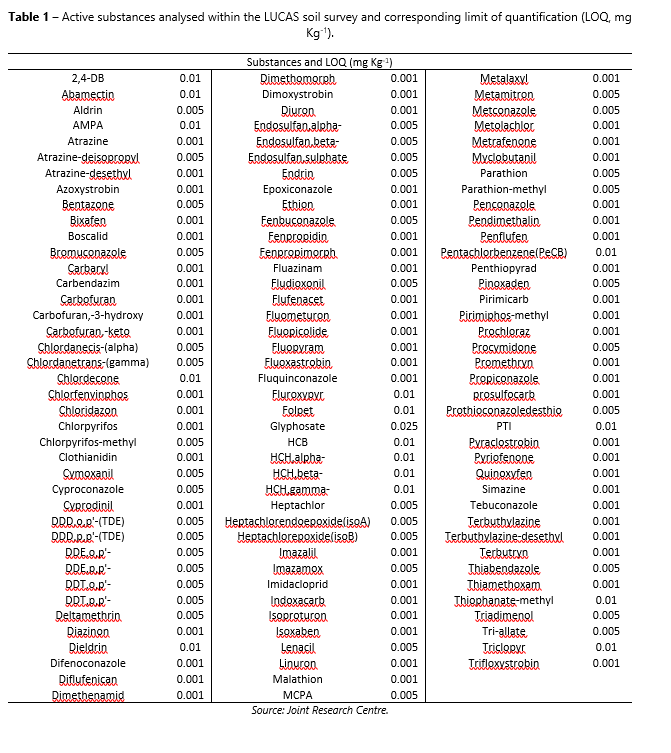
This study, required the analysis of 118 substances (comprising neonicotinoids, conazoles, organochlorinated compounds, and organophosphorus compounds) and metabolites, in soil samples originated from 3,473 sites from LUCAS soil module (Table 1).
Main Results
Only 25.5% of the samples analysed show no presence of pesticides residues (Figure 1). The majority of the samples (57.1% total) present at least two different residues, and of those, 29.8% total presented more than five different residues, while 11.1 % total presented more than 10 pesticides residues. On what concentrations are concerned, most of soil samples (62.1% total) present concentrations levels classified as low to no detection (i.e. LOQ) (Figure 1), and from those, 37.8 % total presented concentrations above the quantification limit. On the other hand, 37.9 % total show pesticide residues concentrations above 0.05 mg Kg-1, being 17.9% of the total above the 0.15 mg Kg-1 threshold, and 3.6% total above the 0.5 mg Kg-1.
Additionally, from the entire universe of combinations between sites (n=3473) and substances under analysis (n=118), 14,106 positive quantifications (Table 2), 12% corresponded to non-approved substances according to the 2018 applicable regulations (Regulation 1107/2009). Under current list of approved and banned substances (May 2023), this would represent 36% of the identifications.

Figure 1 – Pesticide incidence (left panel) and content (right panel) distribution (%) for all soil samples (EU) and by Country. Note number of soil samples in parenthesis.
This study highlights that pesticide residues in soils are widespread in the European agricultural land (74.5% sites), whereas most of the sites (57.1%) present mixtures of substances (two or more) (Figure 2). Additionally, an indicator of the ecotoxicological impact for soil organisms was developed. This indicator compared the concentration of these substances with the no effect concentration (NOEC) for soil organisms, identifying areas at higher risk (1.7% sites). But also, allowed to estimate an increase in ecotoxicological risk when compared with a previous assessment (2015-2018). Finally, among the substances found was also possible to identify banned and non-approved substances in soils (12%), according to the 2018 regulations (Regulation 1107/2009).

Figure 2 – Spatial distribution of pesticide residues incidence classes, from the 3473 sites under analysis, and spatial view of the climatic zones.
This dataset contains the results of a study targeting residues of active ingredients of pesticides used as crop protection products in soil samples collected from the 2018 LUCAS survey. This database presents the average concentrations values in (mg/kg dry weight) obtained for all the 118 substances above their specific Limit of Quantification(LOQ), measured at 3473 sites. Data is reported with a geographical resolution at NUTS2 level due to data protection requirements of the EU General Data Protection Regulation (GDPR).
Key Messages:
- Pesticide use and residues in soils are widespread in the European agricultural soils (74.5%).
- Most of the assessed sites (57.1%) present mixtures of pesticides, and less often (11.1%) more than 10 different substances identified in a single site.
- Comparison with past assessments under the same LUCAS points indicate higher incidence of pesticides residues, and an increased toxicity risk in 2018 when compared to 2015.
- Regulations on the sales of Pesticides, could not prevent the presence of non-approved substances in EU soils.
Data can be donwloaded here
Reference: Vieira, D., Franco, A., De Medici, D., Martin Jimenez, J., Wojda, P. and Jones, A., Pesticides residues in European agricultural soils - Results from LUCAS 2018 soil module, Publications Office of the European Union, Luxembourg, 2023, doi:10.2760/86566
More about LUCAS 2018 in: Orgiazzi, A., Panagos, P., Fernández‐Ugalde, O., Wojda, P., Labouyrie, M., Ballabio, C., Franco, A., Pistocchi, A., Montanarella, L. and Jones, A., 2022. LUCAS Soil Biodiversity and LUCAS Soil Pesticides, new tools for research and policy development. European Journal of Soil Science, 73(5): p.e13299.