
You are here
EUropean SEDiments collaboration (EUSEDcollab) Network
What is EUSEDcollab?
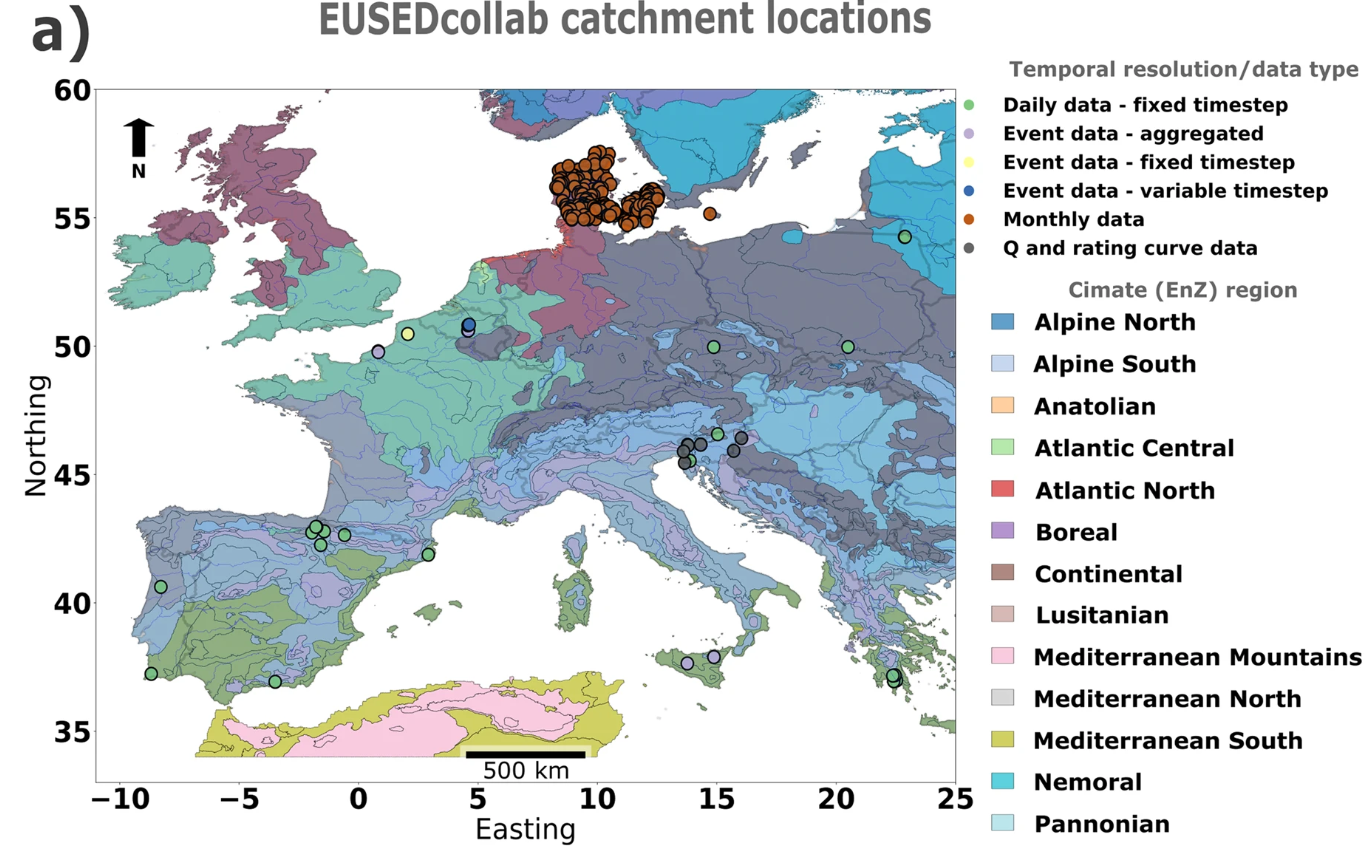
It is a network of data from European catchments to monitor net soil erosion by water. Researchers from many European institutions have come together to create an open-access database (EUSEDcollab) of water discharge and suspended sediment yield time series records collected in small to medium sized catchments in Europe. EUSEDcollab is compiled to overcome the scarcity of open-access data at relevant spatial scales for studies on runoff, soil loss by water erosion and sediment delivery. Through the European Union Soil Observatory (EUSO) working group on soil erosion we harmonised these data into a common time series and metadata structure. Data reuse is facilitated through accompanying metadata descriptors providing background technical information for each monitoring station setup.
EUSEDcollab Database
What can I use it for?
The database has many fundamental and applied uses, with over 40 publications already originating from the data. These catchment studies have already been highly important in developing our fundamental knowledge on runoff, soil erosion and sediment transport in European locations. Measurements in small to medium sized catchments are relatively the most rare, but are critical for developing and validating models which aim to simulate soil erosion and sediment transport on the land surface. Since these data are measured at a spatial scale in which the signal of the processes occurring on land is reflected in the measurement record, these data offer many opportunities to understand the dynamics and magnitudes of soil erosion and sediment delivery. Data compilations offer new opportunities to advance our knowledge and understand how soil erosion changes through time and space, as well as in different land use and environmental settings.How can I contribute?
Further contributions can be made to the database by downloading and completing the data and meta-data template files available in the ESDAC data portal (https://esdac.jrc.ec.europa.eu/content/EUSEDcollab). We welcome data submissions from all potential contributors across the European continent who wish to share access to their catchment measurements. Upon the completion of the metadata and time series fields, data submissions will be first screened and then included in future EUSEDcollab releases. Template submissions can be made by contacting the listed data manager through the contact details listed in the ESDAC data portal.Data manager: Panos.panagos@ec.europe.eu
You can also read the blog "Unlocking the potential of measured data to solve research priorities in soil erosion" developed in Springer Nature
Go Back To
 |
Title: EUropean SEDiments collaboration (EUSEDcollab) database | |
|
Resource Type: Datasets, Soil Threats Data Theme/Sub-Theme: Erosion by water, Sediment transport using WaTEM/SEDEM, EUropean SEDiments collaboration (EUSEDcollab) Network Registration requested: Request Form |
Continent: Year: 2023 |
|

