Various Documents

Other Various documents and publications that can be interested for the public.

Filters

Go Back To

All Documents

Displaying 1 - 4 of 4 |
Policy Brief CRCF
Policy Brief CRCF
Resource Type: Maps & Documents, Documents, Various Documents
Year: 2026

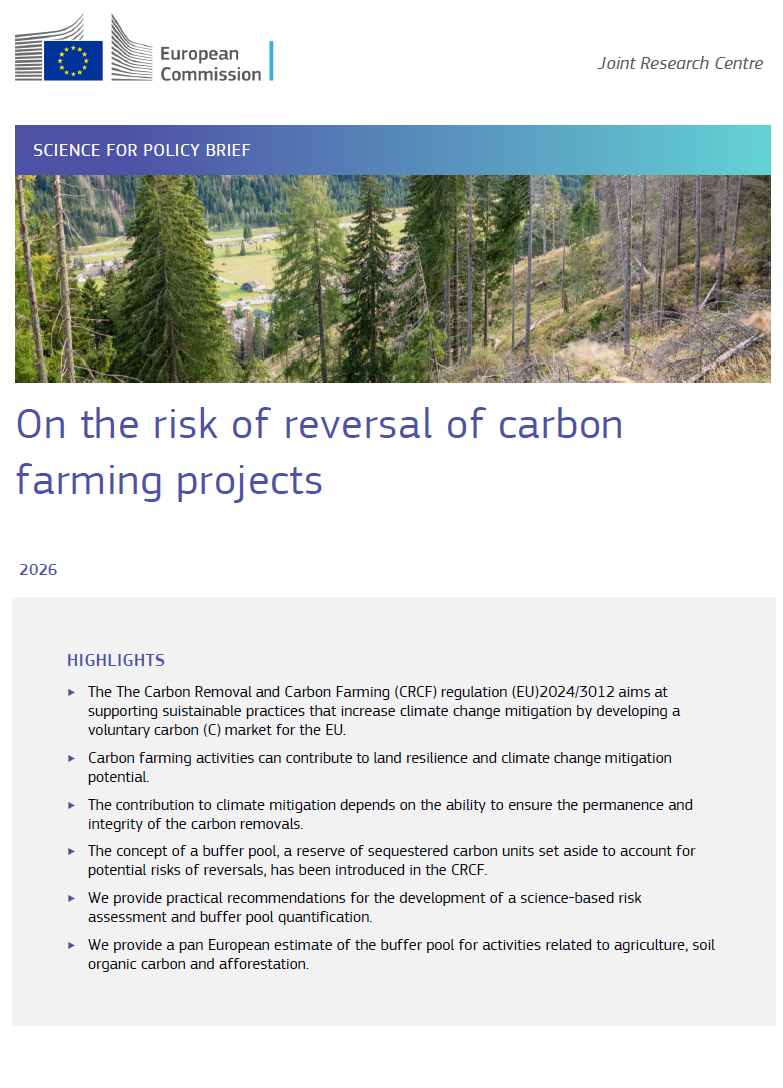
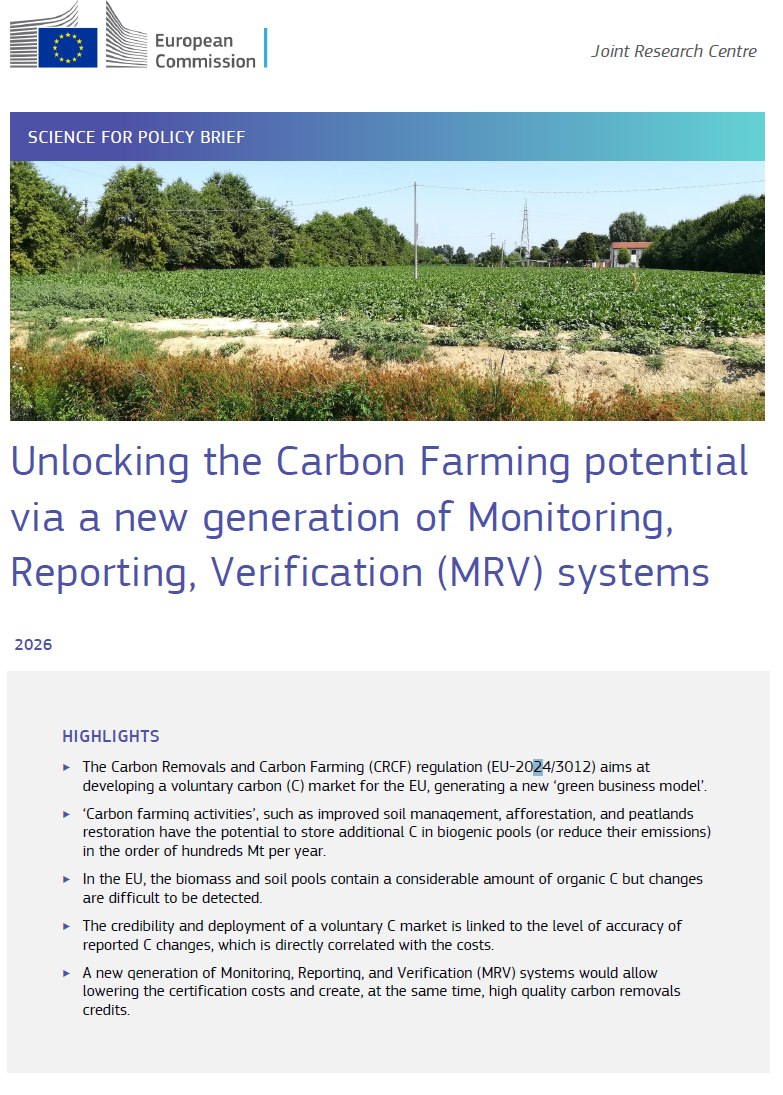
Policy Brief: Unlocking the Carbon Farming potential via a new generation of Monitoring, Reporting, Verification (MRV) systems

  • The Carbon Removals and Carbon Farming (CRCF) regulation (EU-2024/3012) aims at developing a voluntary carbon (C) market for the EU, generating a new ‘green business model’.
  • ‘Carbon farming activities’, such as improved soil management, afforestation, and peatlands restoration have the potential to store additional C in biogenic pools (or reduce their emissions) in the order of hundreds Mt per year.
  • In the EU, the biomass and soil pools contain a considerable amount of organic C but changes are difficult to be detected.
  • The credibility and deployment of a voluntary C market is linked to the level of accuracy of reported C changes, which is directly correlated with the costs.
  • A new generation of Monitoring, Reporting, and Verification (MRV) systems would allow lowering the certification costs and create, at the same time, high quality carbon removals credits.

Download the Policy Brief

Factsheet -  EUSO Activity report 2025
Factsheet - EUSO Activity report 2025
Resource Type: Maps & Documents, Documents, Various Documents
Year: 2026

This is a two page factsheet describing the EUSO’s activities and outcomes in 2025 for:
a) Supporting soil policy
b) EU-wide soil monitoring
c) Monitoring soil health and soil policies
d) Enhancing the functionality of the European Soil Data Centre
e) Supporting soil research and innovation and Supporting stakeholder interactions and soil literacy

Download Factsheet: https://esdac.jrc.ec.europa.eu/public_path//shared_folder/doc_pub/EUSO_ActivityReport2025_Factsheet.pdf

The Angera Declaration for Methane Action
Resource Type: Maps & Documents, Documents, Various Documents
Year: 2026

Two hundred and fifty years after Alessandro Volta discovered methane in the marshes of Angera, the science is now clear: action on methane represents one of the best opportunities to slow global warming. Methane is the second most significant contributor to warming, after carbon dioxide. Methane is responsible for 30% of current warming and its atmospheric concentration continues to rise. Absent rapid and sustained reductions, methane emissions will drive faster warming in the coming decades, intensifying climate risks such  as more frequent and severe droughts and heatwaves; more rapid ice-sheet loss; sea-level rise; and risks of triggering destabilizing climate tipping points.


Reducing methane emissions not only reduces climate risks, it also almost immediately improves air quality by decreasing ground-level ozone, which improves public health by reducing  respiratory illness and premature mortality while preventing crop losses from ozone exposure thus strengthening food security. In recent years, meaningful progress has been made on methane action. We commend the efforts of high-ambition nations, organisations, coalitions, donors, and businesses that have advanced methane mitigation. Initiatives such as the Global Methane Pledge—launched in 2021 and now endorsed by 159 countries and the European Commission—have helped catalyse this momentum by setting a goal of reducing global anthropogenic methane emissions by at least 30% below 2020 levels by 2030. The 2025 Global Methane Status Report shows that while these efforts are slowing the growth of methane emissions, atmospheric concentrations continue to rise. Even greater ambition is needed to match the urgency of the challenge and the scale of the opportunity.

Download the Declaration in EN

Download the Declaration in ITA

Methane turns 250
Methane turns 250
Resource Type: Maps & Documents, Documents, Various Documents
Year: 2026

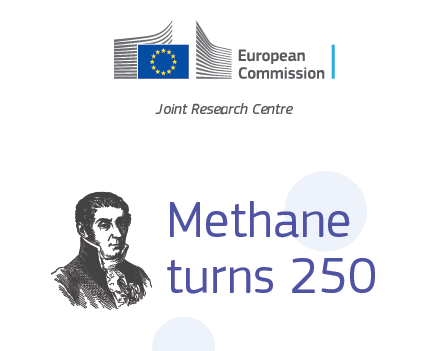
Methane turns 250

2026 marks the 250th anniversary of the discovery of methane (CH₄) in 1776, by Alessandro Volta at the marshes along the shores of Lago Maggiore in Angera.
 
Why is it important?
Volta identified methane as an energy source, later known as a potent greenhouse gas. The Copernicus atmospheric monitoring service utilises satellites, ground tools, and advanced data analysis to monitor global 
methane levels.
 

Download / scarila il leaflet